A
review for Anglicans Online
by Terry Brown
A review of
Church and Settler in Colonial Zimbabwe:
A Study in the History of the Anglican Diocese of Mashonaland/Southern Rhodesia, 1890-1925
By Pamela Welch. Leiden and Boston: Brill, 2008. US$133.00.
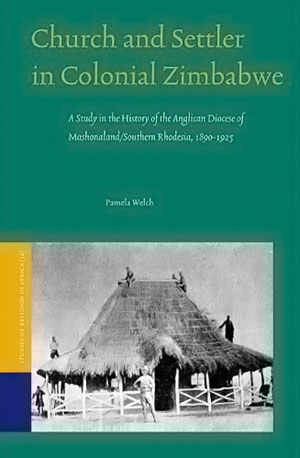 The recent election of Dr Chad Gandiya, Central Africa desk officer of the United Society for the Propagation of the Gospel (USPG) in London, as the new bishop of Harare reminds one how interconnected the African churches and the English mission societies have been and continue to be. In recent years there has been an entirely laudable attempt to do imperial history (including colonial church history) by turning the former object into the subject and taking on the point of view of the colonized (the native convert or teacher), the subaltern (lay missionaries) or the forgotten (women missionaries) rather than the colonizer (the bishop and other white clergy and their relations with central colonial powers). However, in the end it is difficult to understand the whole (or even one group) without understanding all parties, whether powerful or powerless.
Therefore, although Pamela Welch's study of the early history of the Anglican church in colonial Zimbabwe can be faulted for its unapologetic focus on the church and settlers (she points out many other studies already made of the native church and its development), the study is invaluable as a contribution to an understanding of the whole, as well as quite helpful for those working on comparative colonial church history—the lateral relationships, theological issues, and styles of leadership within the late nineteenth and early twentieth century Anglican Communion—especially the relationship of church and culture, and the very frequent tension between indigenous people and settlers within the church (still a global Anglican issue today, though usually phrased differently).
For example, Welch points out that the first four bishops of Mashonaland/Southern Rhodesia alternated between those (the first and third) whose primary interest was native evangelism and the development of an African church, distrusting the colonial enterprise and especially Cecil Rhodes; and those (the second and fourth) who unabashedly supported colonialism, the British South Africa Company and the development of the settler community—all in a continuing single diocese. Welch draws out well these four figures, their ministries, administrations and relationships (including back to England—Cecil Rhodes had his ecclesiastical supporters there). Likewise, SPG itself (the main funder of the diocese) was also in transition over the relative amount of resources, human and financial, to be put into ministry to native and settler congregations. It is no wonder that the Anglican church in Zimbabwe (if not the whole Anglican Communion) is such a contradictory community today. In the end the bishops and missionaries who realized that the future lay with the Africans and not the settlers in Southern Rhodesia were right.
Welch points out that personnel and finances were the diocese's two major problems throughout its early years. She places these issues well in the English and global context of the rapid growth of new dioceses and new missionary societies in the late nineteenth century. She points out, for example, that by 1881 there were some 335 missionary societies known to SPG; therefore, competition for funds and personnel was fierce. No such study can be exhaustive and this book opens the door to many other questions and explorations. For example, the contrast in the SPG administrations of General Secretaries H.W. Tucker (1879-1901) and H.H. Montgomery (1901-1919) needs further work. Welch correctly points out Montgomery's much greater interest in colonial work but does not draw out the underside of that point of view—an often racist view of non-western cultures and people, ("child races") especially in Africa and Asia/Pacific, influenced by late Victorian social Darwinism. In the end history will vindicate Tucker's plodding deeper commitment to the native than to the colonial church. Tucker receives no attention in the book.
(To continue the connection, Tucker, in his 1879 biography of Bishop George Selwyn, identified the point in the last half of the nineteenth century when English public opinion turned away from cynicism to genuine interest in Christian missions—a shift Welch correctly discusses but does not explore deeply—with the death of Bishop John Coleridge Patteson in Melanesia in 1870 and the sympathetic interest it evinced amongst the general public.)
Likewise, a comparative study of the first bishop of Mashonaland, G.W.H. Knight-Bruce, and Bishop G.A. Selwyn, first bishop of New Zealand, would bear fruit, noting their shared mixed loyalties to the peoples they were evangelizing, whether African or Pacific, and to the British Empire, including its armies of conquest. In both cases, the mixed loyalties brought tragedy.
Some of the most interesting material in the book comes near the end in its discussion of inculturation, even for the settler communities—"Religion on the Veld". The only thing I would fault is Welch's argument that the settlers' fondness for Evensong over Sunday morning worship was an innovation of Veld inculturation, having to do with the necessities of agricultural life and the less sacramental setting's being more welcome to all. However, this fondness for Evensong over Sunday morning worship was often a pattern of Church of England life, perhaps for some of the same reasons. In this area, I believe many settlers brought their English preferences with them rather than innovated. One would have also liked some discussion of whether the "advanced" Anglo-Catholic clergy of the diocese had any luck in converting this very Anglican love of Evensong into a love of evening Benediction of the Blessed Sacrament.
I have not done justice to the historical detail of this book which on almost every page sparks questions and leads on to more issues, usually very well discussed. Nor does the author entirely ignore the native church as the Anglican settlers' interaction with them (unfortunately, decreasing with time) is well documented.
The book is well produced (hardback without dust jacket) though very expensive. However, it is a very significant study and even if its price is beyond that of the average reader, one hopes that theological and other libraries will pay the cost and make the book available.
|
Dr Terry Brown is retired Bishop of Malaita in the Anglican Church of Melanesia. |